
Āta process model
The point of this work is you can’t do it alone, when something arises it’s not necessarily yours, and it is arising for us to work with it. The restoration is always in the wound.
To support people and organisations to apply this thinking in a practical way, we have developed a process. It has a flow but is not a neat or linear process. We call it Āta, a reference in Māori to the slow and deep work of relating and reflecting.
The Āta model follows a general flow of:
resourcing people for working in this way
building connection and coherence within the group involved
a process for the group to collectively feel and integrate the collective trauma or issue to be restored
generating the new and the conditions to bring the new into being
continuously learning about and strengthening the approach.
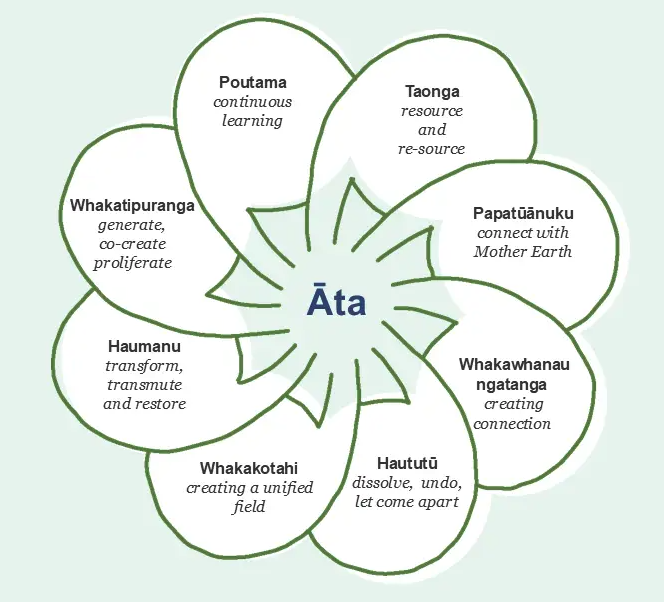
Skillful facilitation of the Āta process by at least two people is required to hold and lead the process. Facilitators and participants need to feel adequately resourced for the work (grounded, calm, present, safe and aware), and to ‘re-source’ ourselves if we don’t.
Taonga/resource and re-source – we draw on group and individual practices that help people access the ventral vagal, building connection and safety for people to relax into. Examples of processes include using karakia (sacred prayers) waiata (song), sound, movement, touch, identifying and doing what resources us in our mind, body, family and spirit.
Papatūānuku/reroot – we bring in the earth and our connections to earth to keep us grounded and connected to earth. Examples of processes include bringing places people love into the room through visualisation or going outside to do sensing and connecting activities.
Whakawhanaungatanga/connection– we create connection between people, weaving the connective tissue, which takes time. Getting to know each other, getting to know each other’s connections to place and people, getting to slowly build trust between people is essential for mahi to be effective, or we spend all our time on solving relational issues.
Haututū/letting come apart – we look at what needs disrupting, letting go, what is not working or disconnected that needs to be changed. Examples of practices include trigger mapping, rewiring processes, understanding how white superiority and human superiority work in our body systems and institutions, reflection, understanding the roots of the white western orthodox worldview, using polarities and paradigm switching.
Whakakotahi/unify - we build a unified field. We need coherent fields of people to be able to realise full potential and for the deeper work of transmuting and restoring past trauma. Team coherence is a place where flow state can emerge and where true productivity is released. It is where we can feel and follow the wairua, the flow of life. Wairua is a harmonising force; it is the intelligence of the universe always present and trying to flow. Example of process to help this include …attunement to self and others, digestion and congruence.
Haumanu/restoration – we connect to a collective trauma field in the room and each person presences how that trauma field arises in them, while others listen. As part of the sharing, the restorative medicine for that trauma usually arrives. We digest, we stay connected to our bodies and to each other, we support, we co-regulate, until it feels like that trauma field or wave has moved through – for now. We debrief on how that felt for everyone and how they feel now.
Whakatipuranga/generate – we create, we generate, we proliferate from the creative energy and flow that usually follows a trauma digestion process.
Poutama – we learn, we capture, we document, we evaluate.
