
What is Haumanu?
The Haumanu framework is an emerging approach to restorative systems change that draws from mātauranga Māori and Western knowledge. It incorporates insights from Theory U, Thomas Hubl’s work on healing collective trauma, and from the wisdom passed down from our collective tupuna or ancestors. Haumanu means to restore and rejuvenate, and the approach provides a conceptual framework, a process method and practices to address collective trauma as it arises, and to redesign our systems from a place of mauri ora (wellness and wholeness).
Bringing restoration into the work of systems change means changing the way we work, relate, design and learn together. Our framework for restorative systems change below indicates how this can work, with the explanation starting from the bottom up – with mauri ora, or the flow of life. The systemic issues are on the left and the strategy for addressing them is on the right. We provide more detail on how we do this work further below.
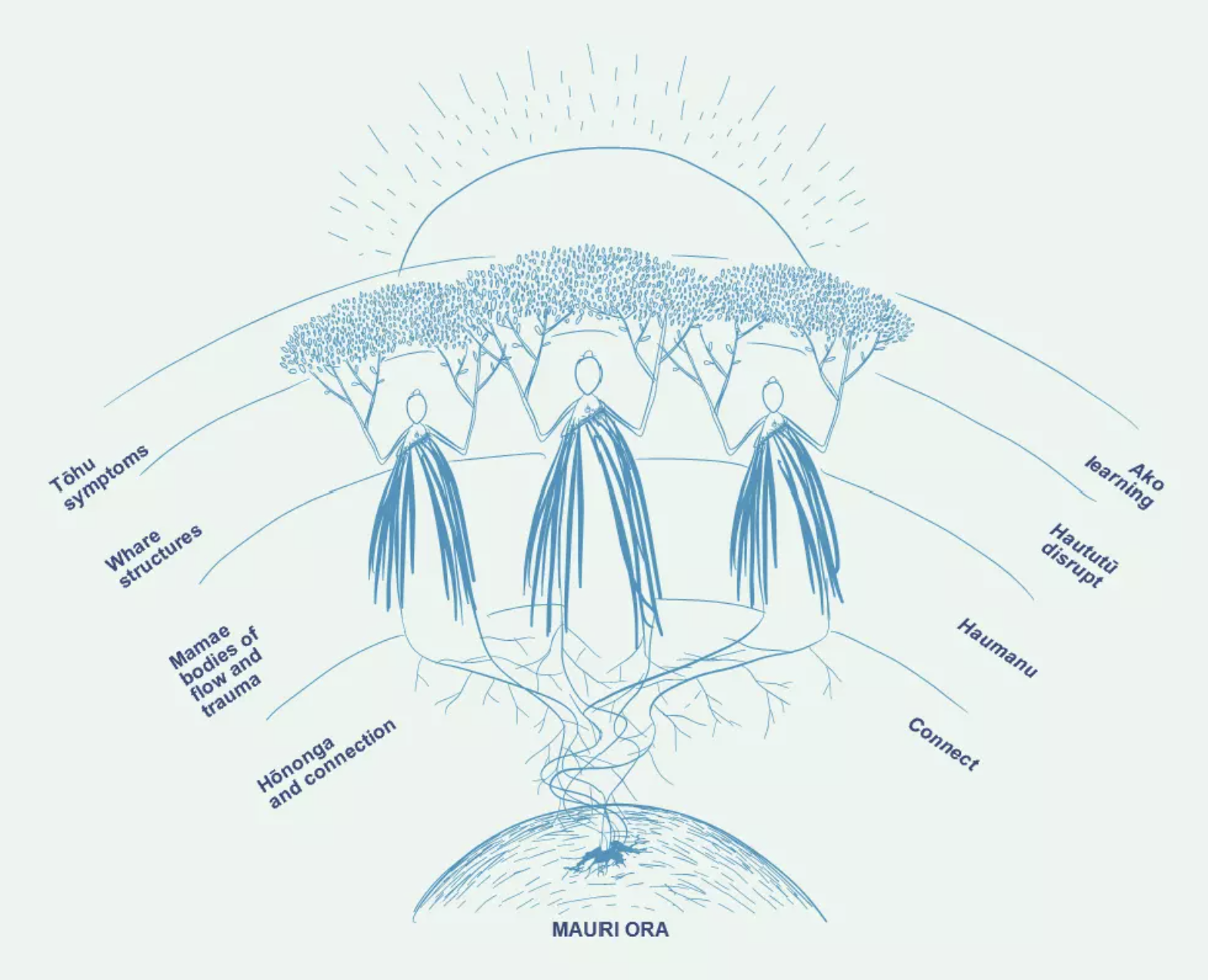
Mauri ora is the place from which we seek to operate – and mauri ora (wellness) is also the purpose of the work. We use practices designed to help us operate from a place of safety, calm and connection to the flow of life.
Hōnonga (relationships)/connect – to address disconnection and trauma we bring people together who want to work in a different way – who want to address collective trauma as it arises and include healing and restoration in their day-to-day work. These people are up for connecting, sharing and learning at deeper levels, for being uncomfortable, for being vulnerable – for depth work.
Mamae (pain and trauma)/haumanu (restore) – trauma stores in our bodies and in the earth; it blocks the flow of energy through our bodies and through the collective. We work in groups to surface, acknowledge and process collective and intergenerational trauma. The usual way of operating is to avoid, ignore, project or repress difficult issues and feelings, or to try and ‘think’ our way through them. Instead, a restorative approach can just become a way of working, as a trauma response or trigger arises, we slow down, we resource ourselves and the group to meet it, and we feel it together.
Whare (structures)/haututū (disrupt) - systems change work in this framework looks at the structures at play and how they affect mauri or life force. The strategy at this layer is to be ‘haututū’ – a disruptor, advocate, to undo and let go - and the energy is of fire and activism. In our organisations and contexts, we can ask what can be stopped, what can be changed and what can be started from an interconnected and holistic paradigm? We work to notice when we have gone into separation and disconnection and pause, so that we can reconnect. We look at the systems or processes we can change or let go of now, and what will take time and how this can begin.
Tōhu (symptom)/Ako (deep learning) - across all layers of the framework is an ako or learning focus, where deep reflective processes are threaded through the group’s work. We employ a developmental evaluation approach, creating feedback loops to shape the work as it goes (see for example Patton, McKegg, Wehipeihana 2016). Tōhu, or signs of progress and change are observed, to guide adaptation.
Much of the current work of systems change occurs in the top two layers of this framework – focusing on the symptoms created by systems and changing the structures that are the most visible face of systems – especially policies, legislation, rules and practices. Trauma will keep leading until we get to the deeper levels, creating from a place of connection rather than disconnection, and healing collective hurts along the way together.
