
Orienting to the miraculous
A Blog by Louise Marra · June, 2026
I want to talk about miracles—and about what happens when we orient ourselves towards the miraculous.
“There are only two ways to live your life. One is as though nothing is a miracle. The other is as though everything is a miracle.”
I have always loved this quote. Recently, during a dream workshop with Peter Levine, the creator of Somatic Experiencing, he mentioned it again, and it stirred something deep within me.
Many years ago, this quote—and another seemingly ordinary encounter—created a pathway in my brain, body, and nervous system that continues to shape how I move through the world.
As I write, I notice some hesitation. Conversations about miracles can easily be dismissed by a culture that privileges logic above mystery, or confined within religious frameworks that often narrow their meaning. Yet that is not what I want to explore here.
I am interested in everyday miracles. Miracle moments.
The subtle yet profound experiences available to us when we learn to orient ourselves differently.
Many years ago, I walked out of an osteopathic treatment and literally bumped into a woman. As we steadied ourselves, I noticed the words printed on her bag:
Be a miracle maker.
I stopped in my tracks.
Something about those words entered me so deeply that I can still feel the impact of that moment. I had no idea why they affected me so strongly, but somewhere inside I knew they belonged to my future.
While it may sound grandiose to speak of miracles as part of our work in the world, I increasingly feel that we live within a field of potential miracles. Learning to orient ourselves—to ourselves, to one another, and to the Earth—in this way opens us to possibilities that our troubled world desperately needs.
In a time marked by war, ecological crisis, and profound suffering, an orientation towards the miraculous is not an escape from reality. It is a way of meeting reality with greater openness, reverence, and hope.
For me, orienting to miracles expands consciousness.
It reminds me that there is always more occurring than I can perceive. It deepens my gratitude for this extraordinary planet and for the beauty and intelligence woven through the natural world.
Over time, I have developed practices that help cultivate this orientation, and I share them in case they might be helpful to you.
Each morning, as part of my prayers, I hold the world in my awareness. I bring attention to places torn by conflict, to communities experiencing devastation, and to the many realms of life—the plant world, animal world, mineral world, oceans, lands, and human communities.
For each, I ask for miracles.
Then I widen the circle to include my whānau, friends, community, the whenua, and the living world that surrounds me.
We all exist within a vast web of relationships—human and more-than-human. Through our attention, intention, love, and prayer, we participate in that web. We can offer light into it. We can offer healing into it. We can offer the possibility of miracles.
What I have noticed through years of practice is that something changes within me as I do this. I feel the quality of the energy I am invoking. I feel it move through me. Whether one thinks of it as grace, consciousness, spirit, or simply love, it is nourishing. I do not need to know where it goes. I trust that it lands where it is needed.
Throughout the day, especially during moments of stress, I return to this practice in a simpler form. I pause and look around for small miracles.
A bud emerging from what appeared to be a lifeless branch.
A bee nestled deep within a flower.
A shaft of light illuminating the maunga.
A kind glance from a stranger.
The vastness of the night sky.
The astonishing fact that this body continues to breathe, heal, and carry me through the world.
Nervous system expert Deb Dana calls these moments glimmers—small experiences that support regulation and wellbeing. I love that term, yet I often think of them as miracle moments: reminders that wonder is never far away.
I have been looking at the new images of a single cell, they are amazing. These images are using AI and other technology to show the complexity of our cells. You can look at these highly detailed 3D Models at Reddit Single Cell Model for a visually stunning 3D rendering of a human cell rebuilt from real X-ray and Cryo-EM molecular data. Seeing the intricate architecture of a single human cell evokes awe. The complexity, artistry, and intelligence contained within us are almost beyond comprehension.
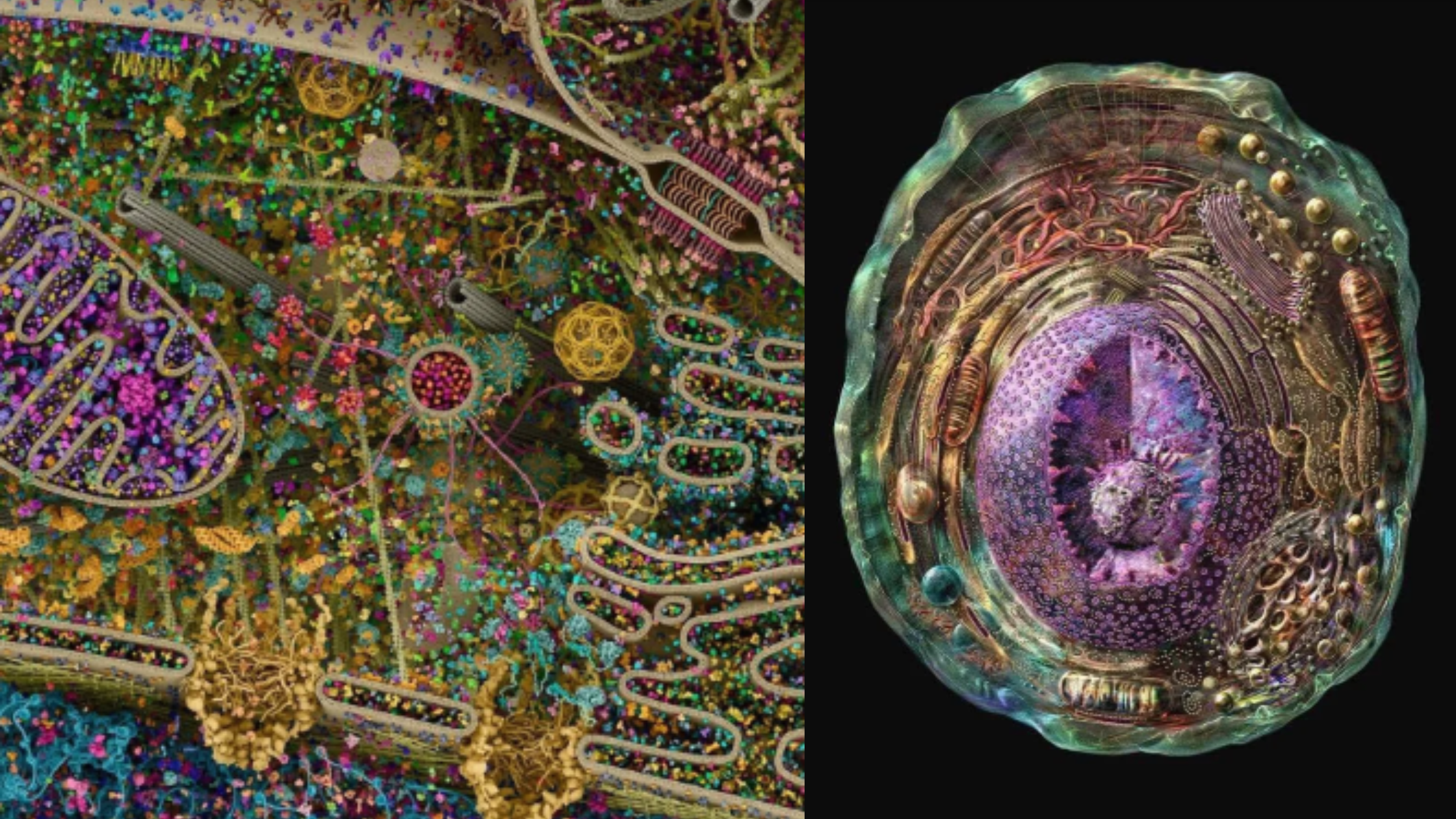
Source: Reddit
Perhaps it is time we remembered that we are not separate from nature.
We are human nature. We are expressions of the Earth’s creativity, participants in its living body.
When we begin to orient towards ourselves and the world in this way, something shifts. We become more available to wonder. More receptive to beauty. More connected to the field of miracles in which we already live.
This brings me to another essential aspect of this practice: receiving.
To notice miracles requires us to activate our receiving department.
Receiving is different from striving. It asks the body to soften its grip on doing and accomplishing. It invites us to become available to what is already present.
For many of us, this is its own profound practice.
What happens in your body when you open to receiving?
What is your relationship to the quote above?
What is your relationship with the miraculous?
Perhaps an invitation for the coming week is to explore these questions. Notice what helps you receive. Practice looking for miracle moments. Include the possibility of miracles in your daily prayers, wishes, or rituals. Offer them to your loved ones, your community, and the wider world.
You may discover that you, too, become a downloader of miracles.
