
How Embodiment Transforms Systems Change
An article by Louise Marra, John Kania, Laura Calderon de la Barca and Lian Zeitz (Collective Change Lab) 21 min read · Mar 4, 2026
Over the past century, society’s understanding of the nature of learning has evolved. Pre 1950, educational efforts emphasized repetition, reinforcement, conditioning and cognitive problem-solving. Students for the most part worked by themselves. Today, educational pedagogy has a more integrated view that recognizes learning as relational, embodied, and shaped by environment and safety.
This is an apt analogy for how the practice of systems change must evolve.
The current mainstream approach to systems change is the equivalent of relying heavily on drills, rewards, and punishments when what’s needed is to shift practice to more integrated and embodied ways of working. Just as education matured beyond drills and rewards, systems change practice must evolve beyond predominantly cognitive approaches to integrating more embodied ways of being and making sense of the world. In the absence of this evolution, we will continue in the state of “stuckness” that characterizes most of our systems today.
How did we get here?
It started with the mind/body conundrum. In 1661, the French philosopher, René Descartes, declared that mind and body are separate (1). This became one of the defining ideas of the Age of Enlightenment. As a result, Western practice has centered cognition as if it were the primary driver of understanding. Yet, science now shows that perception and decision-making are deeply shaped by bodily states. When we ignore this, we needlessly limit the intelligence available to us.
It’s time we update the frame of how the mind and the body together process and act on information, and specifically how this happens in systems. We need to bring the body back into our consciousness, not only to give it its due, but to focus on the ways in which the body adds more — so much more — intelligence and sensory perception to the work. We call this intelligence “embodied sensemaking.”
What is embodied sensemaking?
We define embodied sensemaking as an integrative way of understanding that includes signals from the body, emotions, mind, spirit, relationships, and Earth. It recognizes that meaning is shaped not only by cognition, but by sensation, environment, and relational context. In this integrated sensemaking, the notion of embodiment reminds us that the storehouse of intelligence “from the neck down” is available to us if we just invite ourselves to access it. More than access it, truly inhabit it. And learn from it.
It’s important to note that an emphasis on embodied intelligence has a long lineage in Indigenous cultures and in the world’s wisdom traditions. It has also been a growing area of scientific examination, particularly over the last 15 years. Work in the fields of epidemiology, psychiatry, psychology, neuroscience, somatics, epigenetics, trauma-informed care and collective trauma all point to the leading role the body plays in how people make sense of their surrounding world. A few examples of recent scientific findings:
Emotion starts in the body, not the head. A classic assumption is that: something happens, then the brain thinks, and then the body reacts. Science shows instead that changes in the body — heart rate, breathing, muscle tension, gut activity — often happens first, then the brain interprets those signals as emotion (2). Counter to DesCartes’ assertion, science today shows that the brain-body connection is central to how we think, act and make decisions.(3)
Posture and breathing change mood and cognition. For example, slow, deep breathing activates the parasympathetic nervous system and reduces anxiety. Slumped posture increases feelings of helplessness. Upright posture increases confidence and persistence.(4)
The gut sends more signals to the brain than the brain sends to the gut. About 80–90% of vagus nerve fibers run upward — from body to brain. This means that the gut is constantly informing the brain about safety, threat, nourishment, and stress.(5)
Immune activation changes thoughts and mood. When people’s immune system is activated (e.g. infection, chronic inflammation): they feel tired, social withdrawal increases, motivation drops, and thinking becomes more pessimistic.(6)
Trauma is stored and expressed physically. Trauma research shows that the body can remain in defensive states (e.g. fight, flight or freeze) long after conscious memory fades and even when the person rationally knows they’re safe.(7)
As individuals we are not isolated; we are part of a web of life. Yet simply inhabiting a body does not guarantee that we are consciously connected to all our interdependencies. Many of us live primarily in our heads, cut off from the sensory and relational signals that remind us of this interdependence. When we operate outside of embodiment, our thinking often reflects separation, and separation cannot re-weave a world that requires reconnection to thrive.
Our bodies hold the imprint of our histories and lived experience. If we learn to listen to and work with this embodied intelligence, we can begin to reweave new patterns, within ourselves and within the systems we inhabit.
Systems change and embodied sensemaking
How does embodiment show up in the work of systems change? At its most basic level, we see embodiment showing up as an acknowledgement that there is more to us than the human mind, and that cognition is affected by and embedded in our perception, our senses, our environment and the systems in which we live and work.
The simple acknowledgement that the mind is inherently connected and just one part of the body has profound implications for how we think about systems change. To explore this we’ll take a look at embodiment and systems change through a framework for understanding systems change developed by John Kania (a co-author here), Mark Kramer and Peter Senge in 2016. This framework has become a widely used model around the world for providing insight and taking action to change systems.
As is shown in the diagram below, the authors identified six conditions of systems change operating at three levels of explicitness in a system.
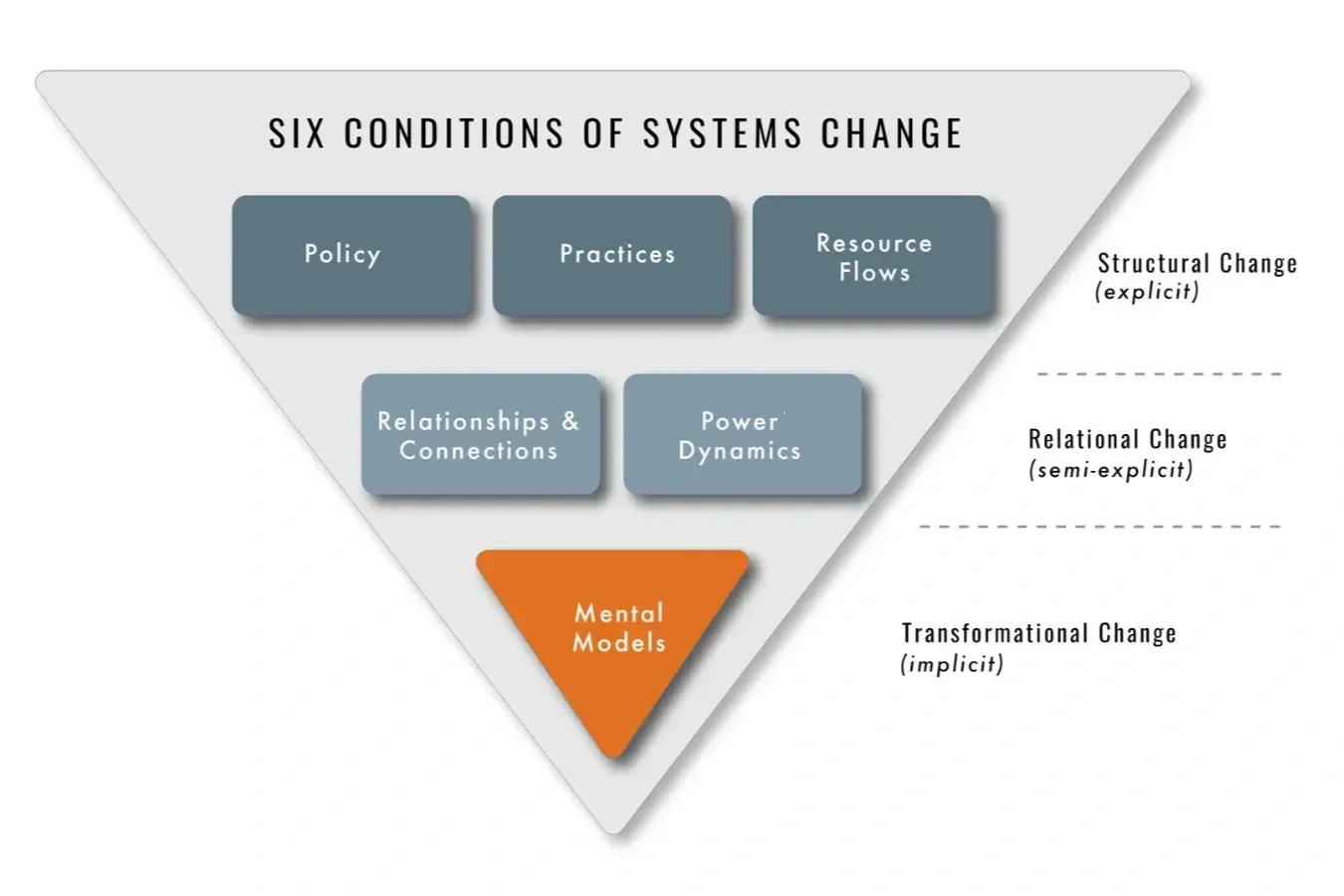
Six Conditions of Systems Change — Source: John Kania, Mark Kramer & Peter Senge, “The Water of Systems Change,” FSG. https://www.fsg.org/publications/water_of_systems_change
They labeled the third level, which is the deepest condition of systems change, as mental models. The authors defined mental models as “habits of thought — deeply held beliefs and assumptions and taken-for-granted ways of operating that influence how we think, what we do, and how we talk.” And they identified mental models as the transformational condition within a system. Shifting mental models, the authors observed, has the potential to shift all other conditions in the system.
If we expand beyond “mental models” to include embodied sensemaking, we gain a deeper view of how meaning is actually made and transformed within systems. Consider resistance to affordable housing. Opposition is often framed in neutral policy language, such as property values, safety, and neighborhood character. Yet beneath these arguments may sit racialized assumptions and inherited narratives about who belongs and who does not. These views are rarely shifted by data alone. They are embodied patterns shaped by history, fear, social conditioning and cultural norms. Durable transformation requires more than cognitive persuasion; it calls for engaging the lived and felt dimensions that sustain the belief.
Or consider a nonprofit leader deciding whether to join a collaboration. Rational analysis may highlight the risks, such as loss of control, added complexity, and difficult partnerships. Yet a prior embodied experience of shared purpose can carry a felt memory of vitality and trust. That memory shapes the decision as powerfully as logic. Ideas may inform us, but transformation becomes durable when people experience connection in ways that reshape how safety, possibility, and belonging are felt in the body.
With the context of these examples, we might re-draw the six conditions triangle to represent several layers of depth at the transformational change level. The first layer of depth would be “cognitive understanding,” as this layer of understanding is brain-centered in its meaning-making. The second layer of depth would be “embodied sensemaking” that would be body-centered in its meaning-making and inclusive of our many senses and intelligences.
With this perspective, it would make sense to refer to the deepest condition of systems change, currently referred to as “mental models,” as “meaning-making models.” This reflects the fact that, as human beings, we make meaning of the world through both cognitive and embodied means.
What are the implications here for systems change? The deeper our meaning-making is, the greater will be our connection to the system. The greater our connection to the system, the more likely it will be that our work supports the system in flourishing. This is illustrated below in a new look at the six conditions of systems change framework.
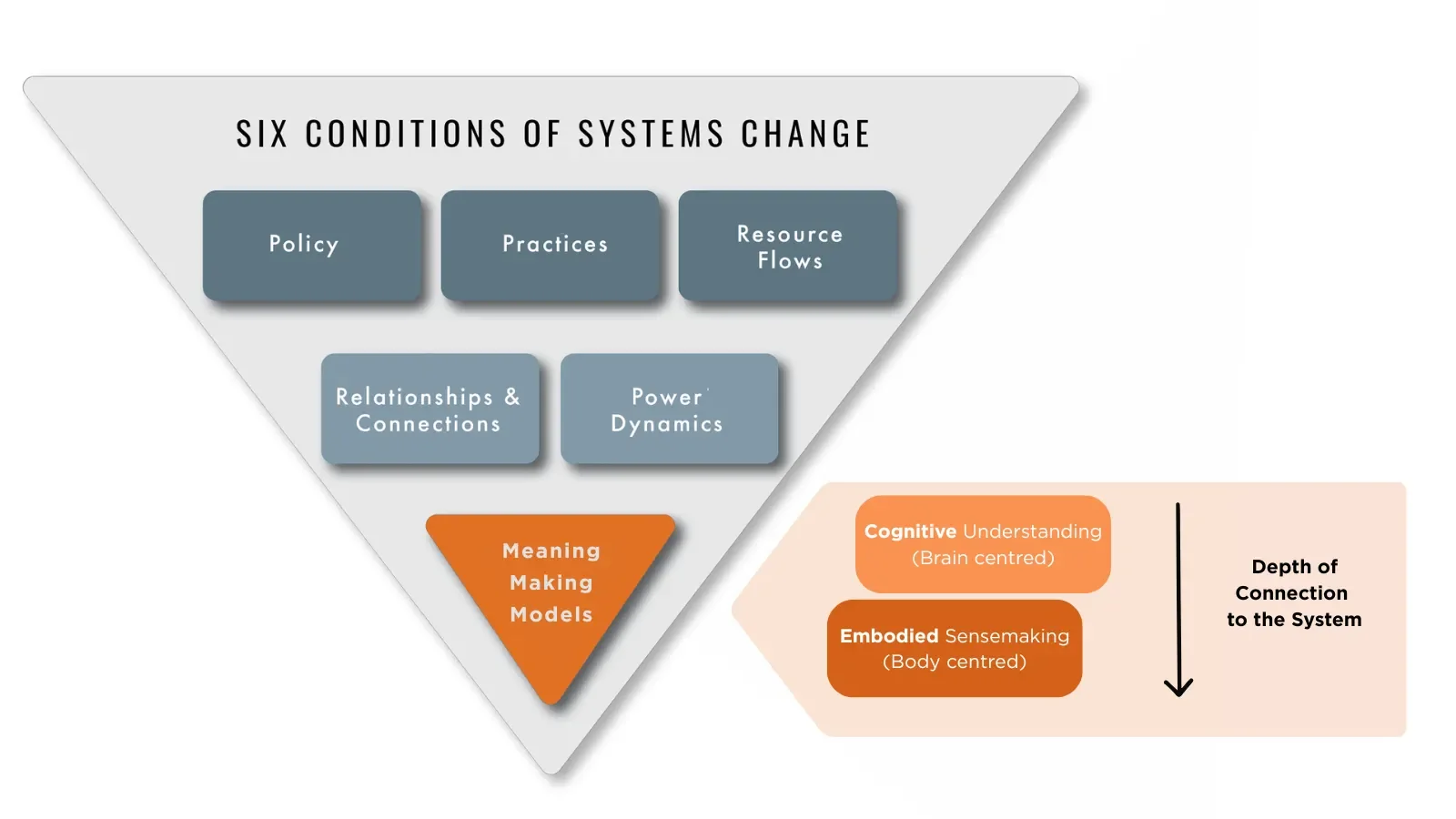
Shifting Meaning Making In Systems
An important implication of the existence of multiple layers of meaning-making within systems is that changemakers can begin to expand the ways in which they consider supporting transformation and re-wiring in the system. Consider the following three ways of shifting meaning-making. The first is focused on shifting cognitive understanding. The second and third focus at a deeper embodied sensemaking level.
Introduce a new cognitive frame that replaces an old one.
According to Frameworks Institute, a leader in advancing knowledge in narrative change, cognitive framing is about “the connections we choose to draw between ideas. For example, is a protest march against violence an exercise in freedom, or is it a threat to security?” The way we frame an issue strongly influences the way we think and feel about it, and what we’re willing to do as a result.
2. Help people into a new relationship.
Consider this: police and youth find themselves together in a healing circle that supports deep listening. After two hours of being in an intimate setting together, bodies side by side, breath intermingling, listening to each others’ hopes and dreams, both groups emerge with a new and almost shocking realization that they are more alike than different. This leads to positive changes in police policies towards engaging youth at risk.
3. Help people into a new experience.
Contrary to popular belief, rather than thinking ourselves into a new way of living, we typically live ourselves into a new way of thinking. Consider a doctor who is an expert diagnostician but eschews the need to treat patients in a caring and compassionate way. He then falls sick, winds up in the hospital and experiences medical staff who are cold and uncaring. For the first time he feels what it’s like to be treated without care when one is sick.
The doctor emerges from this experience a transformed physician, now treating the whole person with respect and empathy. Other physicians working with this doctor see his changes in practice and begin to shift their own practices towards greater compassion and empathy.
Even as we support others in embodying new perspectives, there is still a deeper layer of connection that we can reach for.
Deepening connection through Earth embodiment
As we deepen our embodiment practice, we begin to recognize how profoundly our bodies are linked to the Earth. This deepening becomes “Earth embodiment”: an identity shift from seeing ourselves as separate actors within systems to experiencing ourselves as expressions of the larger web of life. From this place, meaning-making is no longer rooted in separation or self-protection, but in connection and mutual flourishing.
For many who grow up within Western or Euro-centric contexts, this shift can feel both unfamiliar and a leap to integrate. It is important to note that what we call Earth embodiment resonates with ways of knowing long held in many Indigenous cultures and the world’s wisdom traditions, each rooted in distinct worldviews and practices. These traditions, while diverse and belonging to their own peoples, offer a counterpoint to the human–nature separation embedded in much of Western thought. As we explore this connection, we do so with awareness that we are learning from, not replicating or owning, these living knowledge systems.
When we invite this shift from separation to belonging to take root in our bodies, we then begin to see ourselves as part of the Earth’s primordial and ongoing process of evolution and healing. From this essential (re)connection, action feels less forced and more aligned. Change arises from participation in the whole, rather than from striving for connection, resisting it or trying to dominate it. An emphasis on the individual yields way to an emphasis on community and the collective.
Much of systems change activity today emerges from trauma, as people respond to past wounds with actions aimed at reducing pain or regaining control. When action is rooted in unhealed fragmentation, it often reproduces the very patterns it seeks to disrupt. Earth embodiment operates from a different source of power. It creates from connection rather than separation, and therefore generates change that is integrative rather than reactive. In this respect, Earth embodiment becomes the deepest form of meaning-making (in fact, Earth embodiment is ALL of who we are) where we are most connected to the system.
Here, we add a third layer of depth of meaning-making: from cognitive understanding to embodied sensemaking and now to Earth embodiment. The most profound of these meaning-making layers with the most potential for systems change is Earth embodiment. Earth embodiment is not separate from embodied sensemaking or cognitive understanding but is inclusive of them (just as embodied sensemaking is inclusive of cognitive understanding).
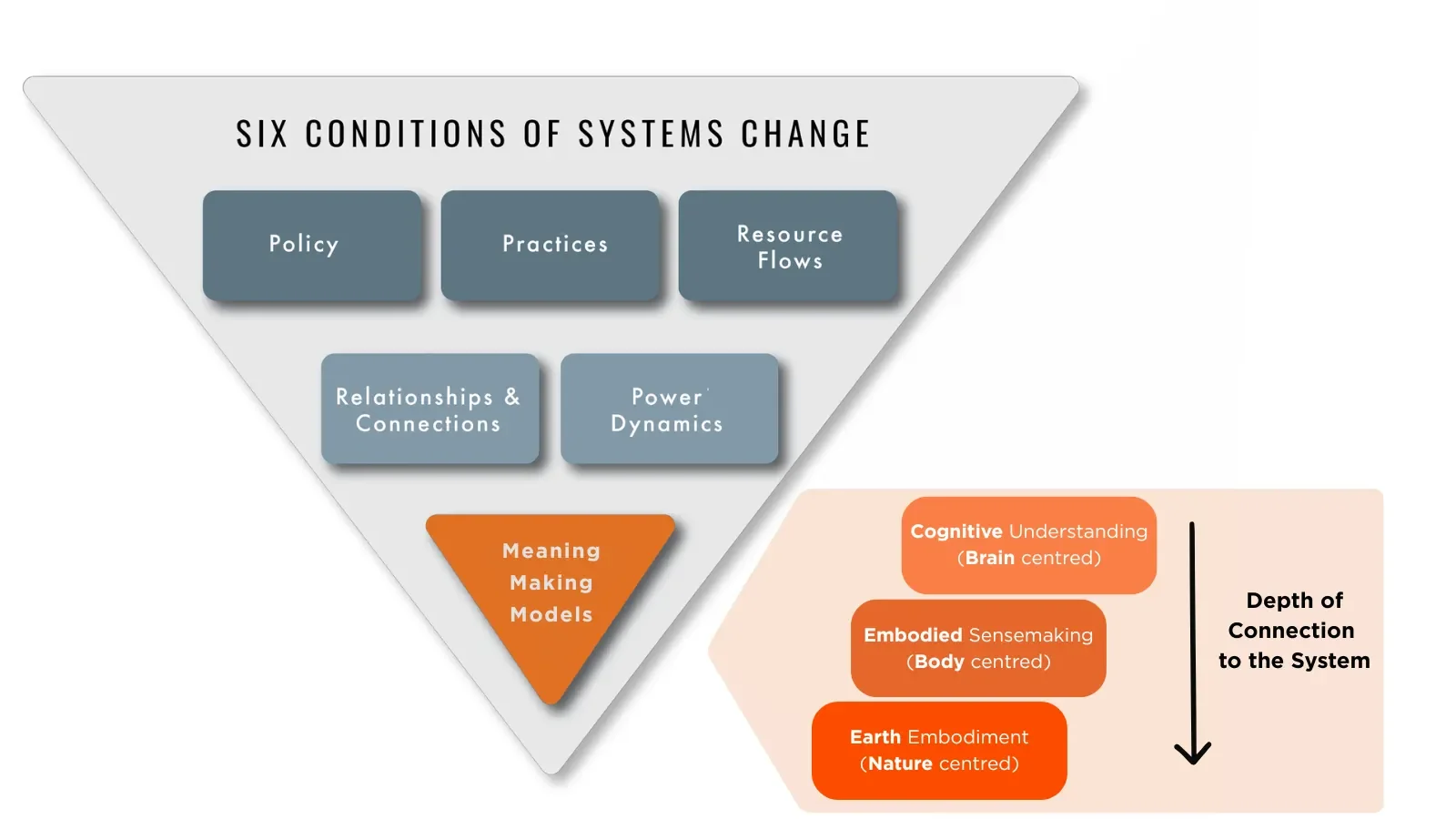
Both embodied sensemaking and Earth embodiment describe a state of being that is deeply connected to the system. And yet the majority of humanity today lives in a state of disconnection brought on by trauma (in fact, according to World Health Survey data, 70%+ of the world’s population has experienced trauma). The implication for systems? Trauma begets trauma and this perpetuates ways of making meaning that see disconnection as a natural state.
The process of healing, individually and collectively, can help shift this view. In fact, when meaning-making is led by trauma — and the prevalence of trauma in the world would indicate that meaning-making is quite often led by trauma — it is impossible for views to shift in a durable way without healing.
With this understanding, we add to the previous three ways of shifting meaning-making a fourth way: Help people to heal. Consequently, the approaches to shifting meaning-making in the system would look like:
Ways of Shifting Meaning-Making in a System
Introduce a new cognitive frame that replaces and old one
Help people into a new relationship
Help people into a new experience
Help people to heal
Helping people to heal may seem a tall order for systems change practitioners. However, as the world becomes more unpredictable and violent, with centuries of intergenerational trauma dragging people and systems down, it is becoming increasingly apparent that, without healing, our systems won’t transform. People experiencing trauma remain stuck in their ways of making meaning. So do systems. This won’t change until trauma becomes healed.
So what might it look like to help people to heal? One way that this is occurring around the globe today is social change practitioners supporting people in telling their stories and sharing their truths.
Consider this: Futures Without Violence, a national violence prevention intermediary in the U.S., worked with three organizations to partner with survivors, mostly women, of domestic violence. These women have experienced harm from the government, health, and social agencies that provide a range of services to them including: crisis support, child protection, legal and law enforcement intervention, emotional and psychological care, and building personal empowerment. Said another way, the agencies who were supposed to help these women through their trauma have caused them further trauma.
FUTURES along with their partners provides guidance and a safer environment for survivors to share their stories with the heads of government agencies. In this process they prepare the women for being able to tell their stories. They also guide agency heads on how to listen carefully and deeply. In some instances, co-creation between survivors and agency heads takes place and this leads to changes in the system that better support survivors. Though not universal, healing also takes place with the survivors and even with some agency heads who share with the women their own stories of abuse and trauma. Stories bring about healing, and healing brings about systems change.
Helping people to heal is not simple or easy, and the timeline most often isn’t quick or linear. Yet, even small steps taken, such as supporting people in telling their stories in meaningful ways can make a large and sustaining difference in shifting meaning-making in a system.
If you wish to take a deeper dive on the connection between healing and systems change we invite you to read another recent article of ours, Healing Systems.
Embodiment and transformation
Taking into account this new representation of the six conditions framework, it becomes clear that the need for systemic rewiring — breaking old patterns in a system and reweaving them for more coherence — requires starting in a different place to what systems change has generally become. It requires that we come from the reality that we are nature, we are part of the Earth, and our embodiment is what brings alive our potential and enables us to flow with life’s energy.
It also requires that, in seeking to change the system, we must, to paraphrase Mahatma Gandhi, “Be the change we wish to see.” To help a system move from cognitive understanding to embodied sensemaking we must do so ourselves. Likewise to support the system’s evolution to full Earth embodiment, we also must evolve in this way. This is the way of transformation.
With the intent of transformation we know that we can systemically rewire, as we know that we can individually rewire ourselves from more limited consciousness and mindsets, into more connected, body-centered, and caring ways of being. If we can do that individually, we can do that collectively. Our collective nervous systems operate in a very similar way to our individual ones. Our individual settled body helps other bodies settle, helping us settle our collective body.
It used to be said that change your thinking and everything will change. Today we understand that when we shift our internal state, the stories we tell about ourselves and the world begin to shift as well. Embodiment reveals how many of our responses are conditioned by past fear, survival strategies, family dynamics, and intergenerational trauma. If we do not interrupt these patterns, they will continue to shape our systems as much as they shape our lives.
Embodied sensemaking and Earth embodiment work with the awareness of this whole process so we can also turn on our biology in more useful and connective ways through the stimulation of the parts in us that want to connect, that want to unite, that can celebrate others, that can turn on our full power and medicine, with love.
Without this turned on, we will fail in our systems change initiatives because they are all like a laced cocktail, laced with disconnect, trauma and power without love. Trauma — the major force that creates disconnection and fragmentation in this world — needs love to break its unhealthy power and hatred.
If we learn to resource — re-source — ourselves we can activate a loving form of power that creates greater safety. When we feel safer, each of us can step more fully into our own medicine and purpose. And when many of us do this together, the forces shaping change begin to shift. What once moved from fear or fragmentation can instead move from love, connection, and life itself. These are the benefits for us, and for the world, of accessing our own embodied sensemaking and Earth embodiment.
A vision for embodied systems change
Today, we are in a world where the vast majority of systems are not embodied and do not reflect the thinking and doing of Earth embodied humans. Rather than focus on seeking to create more embodied systems, the lion’s share of systems work is focused on developing strategies and activities that are wholly disembodied. Work to change the system that is developed from greater embodiment holds many advantages that would help us move towards a more healing orientated state. Consider the following qualities that we would see if systems, and the people in them, were acting from a more embodied, and Earth embodied state:
Strong connection and collaboration across the parts of the system.
Conscious attention to underlying dynamics, including historical trauma and entrenched patterns that shape behavior.
The ability to recognize trauma responses as they arise and pause to restore connection rather than amplify fragmentation.
Action that emerges from grounded connection rather than urgency, fear, or reactivity, enabling the creation of genuinely new futures.
Ongoing reflection that increases the system’s capacity to perceive and understand its own patterns and impacts.
Reduced friction and competition as trust and alignment strengthen across actors.
Decision-making that accounts for social, ecological, and relational impacts, not just isolated outcomes.
Projects and movements seeded from relational alignment rather than strategic urgency alone.
Policy, power, relationships, resource flows, and meaning making approached from an embodied stance.
Attention to resourcing and sustaining all parts of the system, supporting collective thriving rather than extraction.
How we can foster embodied systems
Embodied sensemaking and Earth embodiment are sacred endeavours to begin to inhabit these bodies as part of the Earth’s architecture — using nature as our guide — that our spirit lives in. But this isn’t easy.
It requires intention, dedication and is all about practice.
We are currently practicing being separate, being led by trauma, being on the busy highway of life (which is a trauma highway). We can practice being different, and if we practice together, we will be more successful at the switch needed than if we practice alone.
First, we can start with the very disorientating (to our brain) rewiring around being Earth, our bodies being Earth. We can cognitively make that paradigm switch, which can interrupt the wiring of disconnect. We can do that ourselves and we can do that as systems. It can remind us to come back.
Here are some things we can do:
We can track our sensations in our bodies, noticing them with curiosity and wonder rather than judgement, seeing their patterns and learning from them.
We can cultivate our capacity to feel, paying attention to our internal states, our relationships, and the changing conditions around us.
We can familiarize ourselves with the embodied experience of connection and care, and contrast it with when our state becomes reactive; and when we catch ourselves reacting, practice slowing down and regulating before acting.
We can together discover who we are without our trauma defining us.
We can begin to love our bodies and recognize their profound interbeing. In that recognition, we rediscover the quiet magic of being living ecosystems, rivers flowing within and between us.
We can sit quietly for 25 minutes in contemplation in nature–that gives the creatures in nature time to get used to our presence, and with practice, we can feel that welcome.
We can develop a relationship with a plant in a pot, where we quietly breathe together, and we open our hearts to our and their gratitude for sharing what sustains life for both of us.
We can practice systemic sensing, sensing into what is ready to change and follow those threads.
We can return to the very grounded and essential place of being Earth.
Our systems can be this way. It’s not an impossibility. What it will take, first and foremost, is intentionality and a desire to go beyond the cognitive ways we have envisioned systems, to truly embody systems as the avenue to transformation.
Where embodiment leads us
From the current disembodied state in which most of us find ourselves, the path to becoming embodied and Earth embodied may feel overwhelming. One might wonder, why bother going there?
For starters, as disembodied people, we miss out today on much of what is going on around us, essentially overlooking information and understanding that can help our systems to flourish. Beyond this, the path to embodiment is in itself life-giving. Embodiment brings joy, love, connectedness, belonging, curiosity — all the things that are intrinsically essentially human — back into our weaving with systems.
Embodiment is the practice of fully inhabiting our bodies and allowing their intelligence to guide how we live and how we help systems thrive. It offers hope from a different starting place, one rooted in connection, and invites the quiet wonder of feeling ourselves open.
Endnotes:
Descartes R. The Philosophical Writing of Rene Descartes. 3 vols. Cottinghma J, Stoohoff R, Murdoch D, Kenny A, trans. Cambridge, UK: Cambridge University Press: 1984–1991 [Google Scholar]
Craig, A. How do you feel? Interoception: the sense of the physiological condition of the body. Nat Rev Neurosci 3, 655–666 (2002). https://doi.org/10.1038/nrn894
Peper, Erik & Lin, I-Mei & Harvey, Richard & Perez, Jacob. (2017). How Posture Affects Memory Recall and Mood. Biofeedback. 45. 36–41. 10.5298/1081–5937–45.2.01.
Dantzer R, O’Connor JC, Freund GG, Johnson RW, Kelley KW. From inflammation to sickness and depression: when the immune system subjugates the brain. Nat Rev Neurosci. 2008 Jan;9(1):46–56. doi: 10.1038/nrn2297. PMID: 18073775; PMCID: PMC2919277.
van der Kolk BA. The body keeps the score: memory and the evolving psychobiology of posttraumatic stress. Harv Rev Psychiatry. 1994 Jan-Feb;1(5):253–65. doi: 10.3109/10673229409017088. PMID: 9384857.
Appendix
What Does It Mean To Embody The Conditions of Systems Change?
If people in the system begin from an embodied place, this will significantly impact how they approach their strategies to shift the six conditions. To illustrate, let’s look at how people’s world views towards policy, power and relationships would change if practitioners were to start from a place of deep embodiment.
Embodied policy
Policy development always starts in a paradigm. Unfortunately, policy makers often don’t self-reflect on what paradigm they are developing the policy from. So it is usually in the western orthodox worldview that policies are based on, which is based more on separation of parts. It isn’t a holistic worldview. Evidence gathering is also done within this paradigm, there is using very little evidence that gathers information or data about the true and underlying natures of the problems often at play — colonisation, slavery, white superiority, disconnect from the Earth. So the paradigm from which evidence is gathered reinforces the direction of that policy and keeps us creating policies of inequity, separation and extraction.
If we challenged ourselves to look at policy from a holistic paradigm that takes into account the true source of problems, then we would come up with different policies, and regulations. There would be more deep ways of gathering evidence, there would be different collectives involved at the birth of new policies or regulations. The birth of these would be seeded from connection, from a worldview and experience of connection. It would take into account all the outcomes, social, environmental, and economic, rather than separate them.
It would look at what needed to be healed and restored from the past as part of the policy framework. It would consider the relational fabric needed to change the energy that keeps creating the problems. The process would be entirely different than most policy and regulatory processes currently. We would find ourselves in different solution-making processes also, with freshness coming in from changing the relational container. We would also be using our sensing body all the time to solution- make from a connected place.
Also part of the problem definition would include what trauma fields the issue sits on. All policies generally are sitting on a trauma field from the past. Once we know this, we also would ensure that the policies and subsequent implementation would take into account the capacities needed for the transmutation of those energies.
This would be such a complete paradigm shift! This is a big change from how the western orthodox, world works on problems today. Most often today, policymakers ignore the energy that created the problem and is still circling, waiting to be expressed and wanting to be healed.
Policies would include the healing and restoration of the wrongs and disconnects of the past. That would be radical!
Embodied Power
From an embodiment and Earth embodiment point of view, power, true power is in the connectivity of the whole. It is in the flow of life and working with life force itself. What is life giving, would become a guiding principle. Power that is disconnected from this, disconnected from love would be actively worked with. Past power imbalances would be named and be an upfront part of the process for what was being created. It is part of the paradigm switch needed at the beginning or when a process needs to be disrupted and changed as “power over” arises.
To be openly part of the process we would be asking key questions — what paradigm are we in, who is benefitting and who isn’t in this process, who has the power, is there love with the power or power over, how is it being exercised — as examples. This would be a clean and open part of any process, to clean up superiority and inequity in the processes that are creating change.
Embodied power would work this way: there is natural, Earth embodied hierarchy, where one person has the skills and leadership in an area and they take up the facilitation role, and then when there is another skill needed who someone else has, the role moves to that person. In that way, always the best person for the role that is in line with their medicine is leading that part of a process, policy, or project.
This way we would reconnect power and love back into their rightful marriage.
Embodied relationships and connections
We would approach relationships holistically, including the more than human world in our solution making. We would also not approach relationships idealistically. From an Earth embodiment place we would know that trauma will arise through our relational field, and we would work with rupture and repair in an ongoing way to ensure we keep clearing our field so it can stay as connected and creative as possible as we do the work. We would build the connective tissue of the group, deeply, making the quality of the relational field one of the main outcomes, as this will lead the way.
If the field is fragmented and creating solutions, the solutions are born from fragmentation and will continue this energy, which will create more fragmentation as it lives into the world. If when we are creating anything we come back to love, curiosity, creativity and groundedness in our bodies and transform the energies together around an issue first, then we send out our actions into the world with transformational energies of love and inspiration.
We have many tools and processes to help groups do this, and also many exist within Indigenous, or creative communities, and within the cultural depths of the cultures coming together. Ritual making is such a powerful thing for groups to create together that helps transform the energies of the past into presence so new futures can arrive.
